 Lean
What a graph means
A graph is syntax. To say whether a graph is true we need something it talks about: an interpretation, a little world with things in it and relations between them. RDF 1.1 Semantics §5 defines the simplest kind, and LeanRDF transcribes it.
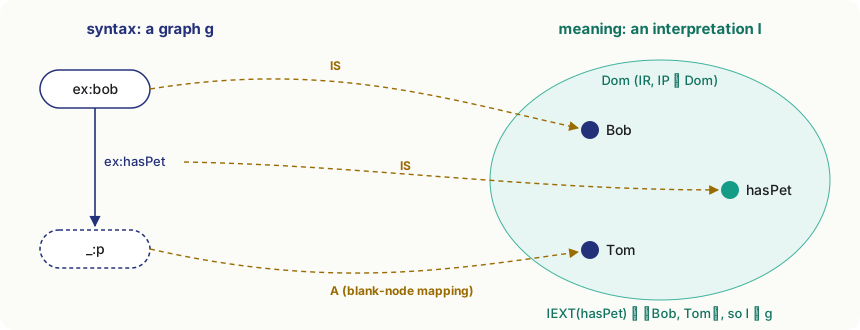
Simple interpretations
A simple interpretation has
- a non-empty set IR of resources,
- a set IP of properties, which may overlap IR,
- IEXT, the extension of each property: the pairs it relates,
- IS, mapping each IRI to a resource or property,
- IL, a partial map from literals to resources.
In Lean all of these live on one carrier Dom, with IR and IP as predicates, so that one thing can be a resource and a property at the same time — RDFS needs that constantly:
structure SimpleInterp where
  Dom : Type
  IR : Dom → Prop
  IP : Dom → Prop
  IEXT : Dom → Dom → Dom → Prop      -- IEXT p x y : ⟨x, y⟩ ∈ IEXT(p)
  IS : IRI → Dom
  IL : Literal → Option Dom
  IR_nonempty : ∃ x, IR x
  IEXT_wt : ∀ p x y, IEXT p x y → IP p ∧ IR x ∧ IR y
  IS_wt : ∀ i, IR (IS i) ∨ IP (IS i)
  IL_wt : ∀ l x, IL l = some x → IR x
When is a triple true?
A term denotes something under a blank-node mapping A: IRIs through IS, literals through IL (possibly not at all), blank nodes through A. A triple holds when all three terms denote, the predicate is a property, and the pair is in its extension:
def SimpleInterp.Holds (A : BlankNode → I.Dom) (t : Triple) : Prop :=
  ∃ s p o, I.denote A t.s = some s ∧ I.denote A t.p = some p ∧ I.denote A t.o = some o ∧
    I.IP p ∧ I.IEXT p s o
A literal with no referent makes its triple false, exactly as §5 says. The definition works for generalized triples too.
Blank nodes are existential
A graph is true when some mapping of its blank nodes into IR makes every triple true:
def SimpleInterp.Satisfies (g : Graph) : Prop :=
  ∃ A : BlankNode → I.Dom, (∀ b, I.IR (A b)) ∧ ∀ t ∈ g, I.Holds A t
So _:p rdf:type ex:Cat says "there is a cat". This is why a query like is there a person with a pet that is a mammal? is itself a graph with blank nodes.
Entailment
A graph g entails h when every interpretation satisfying g satisfies h:
def Graph.SimpleEntails (g h : Graph) : Prop :=
  ∀ I : SimpleInterp, I.Satisfies g → I.Satisfies h
Two facts follow quickly and are proved in the tests:
- the empty graph is true in every interpretation;
- every graph simply entails its subgraphs.
Simple entailment knows nothing about vocabulary: rdfs:subClassOf is just another IRI. To make the RDFS vocabulary mean something we restrict which interpretations count. That is the next chapter.
The quantifier is over interpretations whose carrier lives in Lean's
Type. That is a recorded simplification; it does not weaken soundness, because a statement proved for every interpretation inTypestill holds of each one.