 Lean
Examples
There are two kinds of examples, and both are tested.
- Runnable examples in
examples/: data, queries and shapes for every command-line tool, with the expected output of each run inexpected/.scripts/examples.shruns them all and compares the output, and CI runs it on every push. - Lean snippets from the test suite, which compiles on every
lake test. Each heading names its file.
| Example | Tool | Shows |
|---|---|---|
examples/rdfs-university/ | leanrdf-demo | RDFS entailment through subclass chains, domains, ranges and subproperties, and an honest "not derived" |
examples/sparql-library/ | leanrdf-sparql | OPTIONAL, aggregates, date filters, NOT EXISTS, CONSTRUCT and ASK, and a difference from oxilite |
examples/shacl-employees/ | leanrdf-shacl | a conforming and a non-conforming graph, six kinds of violation |
examples/owl-rl-family/ | leanrdf-oxilite | oxilite's OWL 2 RL answers and closure certified from a recording, including a wrong explanation |
examples/owl-el-anatomy/ | leanrdf-classify | a SNOMED-style EL ontology classified, with an unsatisfiable class |
elpi/examples/ | leanrdf-demo | the pet ontology used throughout the book |
The Lean snippets share these helpers (the test files define their own equivalents):
open LeanRDF Vocab

def ex (n : String) : Term := .iri ⟨"http://example.org/" ++ n⟩
def T (s p o : Term) : Triple := ⟨s, p, o⟩
def sc : Term := .iri rdfs.subClassOf
def ty : Term := .iri rdf.type
1. Build a graph and ask about it
Tests/Core/Graph.lean
def t1 : Triple := ⟨ex "a", ex "p", ex "b"⟩
def t2 : Triple := ⟨ex "b", ex "p", ex "c"⟩

#guard decide (t2 ∈ Graph.ofList [t1, t2])
#guard (Graph.ofList [t1, t2, t1]).toList.length == 2           -- a set: duplicates vanish
#guard ((Graph.ofList [t1, t2]).insert t1).size == (Graph.ofList [t1, t2]).size

example (g h : Graph) (t : Triple) : t ∈ g ∪ h ↔ t ∈ g ∨ t ∈ h := Graph.mem_union
2. Parse Turtle, write N-Triples
Tests/Turtle/Parse.lean
#guard (Turtle.parse "@prefix ex: <http://example.org/> . ex:s ex:p \"v\" .").toOption.map
    (·.toNTriples.toOption)
  == some (some "<http://example.org/s> <http://example.org/p> \"v\" .\n")

-- relative IRIs resolve against the base (RFC 3986 §5.2)
#guard Turtle.resolve "http://a/b/c/d;p?q" "../g" == "http://a/b/g"
3. Derive a triple and get an entailment
Tests/Entailment/Rules.lean. From A ⊑ B and x a A, rule rdfs9 derives x a B; soundness turns the derivation into RDFS entailment.
def g : Graph := Graph.ofList [T (ex "A") sc (ex "B"), T (ex "x") ty (ex "A")]

def σ9 : Subst := fun n =>
  if n = "xxx" then ex "A" else if n = "yyy" then ex "B" else ex "x"

theorem x_type_B : Derives rdfsRules g (T (ex "x") ty (ex "B")) := by
  have d := Derives.apply (rules := rdfsRules) (g := g) rdfs9 σ9 (by simp [rdfsRules, rdfsBasicRules])
    (by simp [rdfs9]) (fun b hb => by
      simp only [rdfs9, List.mem_cons, List.not_mem_nil, or_false] at hb
      rcases hb with rfl | rfl <;> exact .fact (by rw [g, Graph.mem_ofList]; decide))
  have e : rdfs9.head.apply σ9 = T (ex "x") ty (ex "B") := by decide
  exact e ▸ d

example : g.RDFSEntails (Graph.singleton (T (ex "x") ty (ex "B"))) := Derives.sound x_type_B

-- the same as a query with a blank node: "something is a B"
example : g.RDFSEntails (Graph.ofList [⟨.bnode ⟨"who"⟩, ty, ex "B"⟩]) := by
  refine Derives.sound_graph (fun _ => ex "x") fun t ht => ?_
  rw [Graph.mem_ofList, List.mem_singleton] at ht
  subst ht
  exact x_type_B
4. Write a certificate by hand
Tests/Cert/Check.lean. Two rule applications: rdfs11 for A ⊑ C, then rdfs9 for x a C.
def cert : Certificate :=
  { nodes := [ ⟨0, T (ex "A") sc (ex "B"), "fact", []⟩, ⟨1, T (ex "B") sc (ex "C"), "fact", []⟩,
               ⟨2, T (ex "x") ty (ex "A"), "fact", []⟩,
               ⟨3, T (ex "A") sc (ex "C"), "rdfs11", [0, 1]⟩,
               ⟨4, T (ex "x") ty (ex "C"), "rdfs9", [3, 2]⟩ ]
    goals := [4] }

#guard (check rdfsRules g cert).toOption == some (T (ex "x") ty (ex "C"))

theorem x_type_C : Derives rdfsRules g (T (ex "x") ty (ex "C")) :=
  checkB_sound (c := cert) (by native_decide)
Swap the premises of node 4 to [2, 3] and the checker rejects it: body patterns match premises in order.
5. Let Elpi find the certificate
elpi/BridgeTests/EndToEnd.lean. Parse N-Triples, saturate in Elpi, certify, check, and obtain the theorem.
def g : Graph := (NTriples.parse data).toOption.getD ∅
def q : Graph := (NTriples.parse
  "_:pet <http://www.w3.org/1999/02/22-rdf-syntax-ns#type> <http://example.org/Animal> .\n").toOption.getD ∅

def cert : Certificate := (entailmentCertificate g q).toOption.getD default

#guard cert.nodes.length == 7 && cert.mapping == [(⟨"pet"⟩, .iri ⟨"http://example.org/rex"⟩)]

theorem g_entails_q : g.RDFSEntails q := checkQueryB_sound (c := cert) (by native_decide)
6. Prove that something is not entailed
Tests/Semantics/Vacuity.lean. Pick a model of the small-model family in which ex:A is empty; A ⊑ B holds there, B ⊑ A does not.
def emptyA : Params where
  isCustom := fun c => c == ex "A"
  custExt := fun _ _ => False
  isCustomProp := fun _ => false
  propExt := fun _ _ _ => True
  hClass := by decide
  hProp := ⟨rfl, rfl⟩

theorem subClassOf_not_symmetric :
    ¬ (Graph.ofList [T (ex "A") sc (ex "B")]).RDFSEntails
      (Graph.ofList [T (ex "B") sc (ex "A")])
7. Run the demo
elpi/examples/. The pet ontology, and the question "is someone a person with a pet that is a mammal?"
$ lake exe leanrdf-demo examples/pets.nt examples/query-mammal-owner.nt --cert cert.json
LeanRDF: 11 data triples, 3 query triples
Elpi closure under 67 rules: 201 triples
Query instance: _:owner ↦ <http://example.org/bob>
Query instance: _:pet ↦ <http://example.org/tom>
Certificate: 6 nodes, goals [1, 4, 5]
  [0] <http://example.org/Cat> <http://www.w3.org/2000/01/rdf-schema#subClassOf> <http://example.org/Mammal>  (fact)
  [1] <http://example.org/bob> <http://example.org/hasPet> <http://example.org/tom>  (fact)
  [2] <http://example.org/hasPet> <http://www.w3.org/2000/01/rdf-schema#domain> <http://example.org/Person>  (fact)
  [3] <http://example.org/tom> <http://www.w3.org/1999/02/22-rdf-syntax-ns#type> <http://example.org/Cat>  (fact)
  [4] <http://example.org/bob> <http://www.w3.org/1999/02/22-rdf-syntax-ns#type> <http://example.org/Person>  (rdfs2 [2, 1])
  [5] <http://example.org/tom> <http://www.w3.org/1999/02/22-rdf-syntax-ns#type> <http://example.org/Mammal>  (rdfs9 [0, 3])
Certificate written to cert.json
Verdict: ENTAILED. The certificate was accepted by the verified checker (compiled).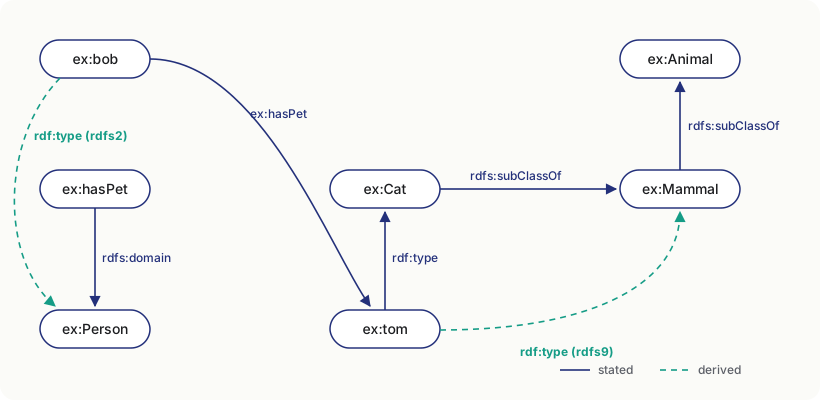
8. Certify oxilite's answers
elpi/BridgeTests/Oxilite.lean. oxilite answers the same pet query with RDFS reasoning by query rewriting. leanrdf-oxilite asks it for the answers, then certifies each one twice: from oxilite's own why proof tree, translated rule by rule, and from a certificate Elpi finds. Both go through the same verified checker.
$ lake exe leanrdf-oxilite examples/pets.nt examples/query-mammal-owner.nt --oxilite oxilite
oxilite answers: 2
[0] ?owner = <http://example.org/alice>, ?pet = <http://example.org/rex>
    elpi: certified
    why:  certified
    verdict: CERTIFIED
[1] ?owner = <http://example.org/bob>, ?pet = <http://example.org/tom>
    elpi: certified
    why:  certified
    verdict: CERTIFIED
Alice owns Rex only through hasDog rdfs:subPropertyOf hasPet, and Rex is a mammal only through the range of hasDog. oxilite explains it with prp-spo1, prp-rng and cax-sco, which the translator maps to rdfs7, rdfs3 and rdfs9. An answer that does not follow, such as Bob owning Rex, is reported not derived and the command exits with 1. --record DIR saves oxilite's outputs, and --results/--why-dir replay them without oxilite.
9. Query with SPARQL
sparql/. leanrdf-sparql takes oxilite's flags and runs a query with the evaluator that is proven to compute the SPARQL semantics. It passes the 97 syntax tests and 257 evaluation tests of the W3C SPARQL 1.1 query suite.
$ cd sparql
$ lake exe leanrdf-sparql query --location ../elpi/BridgeTests/data/oxilite/pets/data.ttl \
    --query 'PREFIX ex: <http://example.org/>
             SELECT ?owner (COUNT(?pet) AS ?n)
             WHERE { ?owner ex:hasPet|ex:hasDog ?pet } GROUP BY ?owner' --results-format tsv
?owner	?n
<http://example.org/bob>	1
<http://example.org/alice>	1
scripts/sparql-diff.sh /path/to/oxilite runs the whole suite on both engines and writes sparql/diff-report.md.
10. A rule of your own
elpi/BridgeTests/CustomRule.lean. A new rule, its soundness proof, Elpi saturation with it, and the theorem. The book chapter Adding a rule of your own goes through it step by step.
def domainViaSub : Rule :=
  { name := "domain-via-sub"
    body := [⟨v "a", c rdfs.subPropertyOf, v "b"⟩, ⟨v "b", c rdfs.domain, v "c"⟩,
             ⟨v "x", v "a", v "y"⟩]
    head := ⟨v "x", c rdf.type, v "c"⟩ }

theorem domainViaSub_sound : domainViaSub.Sound := by
  intro I hI A σ _ hb
  obtain ⟨a, b, ha, hb1, h1⟩ := holds_iri (hb _ (.head _))
  obtain ⟨b', k, hb2, hk, h2⟩ := holds_iri (hb _ (.tail _ (.head _)))
  obtain ⟨x, a', y, hx, ha', hy, h3⟩ := holds_any (hb _ (.tail _ (.tail _ (.head _))))
  cases same hb1 hb2
  cases same ha ha'
  exact Holds.intro I hx rfl hk (hI.domain _ _ _ _ h2 (hI.subProp_ext _ _ h1 _ _ h3))

private def cert : Certificate :=
  ((saturate myRules g) >>= fun cl => certify cl (Graph.singleton goal)).toOption.getD default

theorem marie_lecturer : g.RDFSEntails (Graph.singleton goal) :=
  Derives.my_sound (checkB_sound (c := cert) (by native_decide))
11. RDFS on a university
examples/rdfs-university/. Is some staff member teaching a course that a student takes? The data never says so. Marie leads a course, leads is a subproperty of teaches, teaches has domain Lecturer, and lecturers are staff.
$ cd examples/rdfs-university
$ leanrdf-demo university.nt query-staff-teaches.nt
Query instance: _:c ↦ <http://example.org/uni#logic101>
Query instance: _:s ↦ <http://example.org/uni#emmy>
Query instance: _:t ↦ <http://example.org/uni#marie>
Certificate: 14 nodes, goals [9, 2, 12, 10, 13]
  ...
  [10] <…#marie> <…#teaches> <…#logic101>  (rdfs7 [5, 6])
  [11] <…#marie> rdf:type <…#Lecturer>  (rdfs2 [7, 10])
  [13] <…#marie> rdf:type <…#Staff>  (rdfs9 [0, 11])
Verdict: ENTAILED. The certificate was accepted by the verified checker (compiled).
query-kurt-teaches.nt asks whether Kurt, a professor, teaches something. Being a professor says nothing about teaching, so the answer is NOT DERIVED and the exit code is 1. The tool does not claim the opposite: it reports that no derivation was found.
12. SPARQL from Lean and from the command line
sparql/SparqlTests/Examples.lean and examples/sparql-library/.
private def ask (q : String) : Except String Answer := do
  execute D (← (parseQuery q).mapError toString)

#guard (ask "PREFIX : <http://example.org/>
  SELECT ?n WHERE { :ada :knows ?f . ?f :name ?n } ORDER BY ?n").toOption.map (·.toTsv)
  == some "?n\n\"Alan\"\n\"Grace\"\n"
$ leanrdf-sparql query --location library.ttl --query "$(cat 3-on-loan.rq)" --results-format tsv
?member ?title ?due
"Ben" "The Fifth Season"@en "2026-10-28T12:00:00Z"^^<http://www.w3.org/2001/XMLSchema#dateTime>
"Ana" "Solaris"@en "2026-11-02T12:00:00Z"^^<http://www.w3.org/2001/XMLSchema#dateTime>2-books-per-author.rq leaves Stanisław Lem's average page count unbound, because one of his books has no page count. That follows §18.5, while oxilite answers 204. The SPARQL chapter explains why.
13. SHACL from Lean and from the command line
shacl/ShaclTests/Examples.lean and examples/shacl-employees/.
theorem good_conforms : DataConforms good shapes :=
  (validate_conforms good shapes).1 (by native_decide)

theorem bad_does_not_conform : ¬ DataConforms bad shapes := fun h =>
  absurd ((validate_conforms bad shapes).2 h) (by native_decide)
$ leanrdf-shacl validate --data invalid.ttl --shapes shapes.ttl
@prefix sh: <http://www.w3.org/ns/shacl#> .
[ a sh:ValidationReport ;
sh:conforms false ;
sh:result
[ a sh:ValidationResult ;
sh:focusNode <http://example.org/hr#alan> ;
sh:resultPath <http://example.org/hr#name> ;
sh:sourceConstraintComponent <http://www.w3.org/ns/shacl#MaxCountConstraintComponent> ; ... ],
...The six results are two names for Alan, his manager who is not an employee, a contractor with no e-mail address and an age of 12, an e-mail address without an @, and a team lead who is not in the team. The command exits with 1.
14. An OWL 2 RL certificate
owl/OwlTests/Rules.lean. One step of prp-inv1, checked under owlRules and rejected under the RDFS rules, which do not know it.
#guard (check owlRules family invCert).toOption == some (T (ex "b") (ex "hasParent") (ex "a"))
#guard (check RDFS.rdfsRules family invCert).toOption.isNone

theorem family_entails : family.OWLEntails (Graph.singleton (T (ex "b") (ex "hasParent") (ex "a"))) :=
  Derives.owl_sound (checkB_sound (c := invCert) (by native_decide))
15. Auditing oxilite's OWL closure
examples/owl-rl-family/, replayed from a recording, so oxilite is not needed.
$ leanrdf-oxilite data.ttl pattern.ttl --profile owl --results recorded/results.json --why-dir recorded
[1] ?unit = <http://example.org/org#compilers>
    elpi: certified
    why:  untranslated (oxilite gave no rule: explained above)
    verdict: CERTIFIED
$ leanrdf-oxilite data.ttl --materialized --inferred recorded/inferred.tsv
oxilite inferences: 31, certified: 16
oxilite's answer is right, but its explanation is circular: it explains the transitive partOf triple by prp-inv from its own inverse. LeanRDF certifies the answer from Elpi's derivation by prp-trp instead. The 15 inferences that are not certified are all x rdf:type owl:Thing, which OWL 2 RL does not derive. See Certifying a database.
16. Classifying an EL ontology
examples/owl-el-anatomy/. Diseases defined by what they are and where they are.
$ leanrdf-classify anatomy.ttl
certified subsumptions: 36, unsatisfiable classes: 2
...
:Endocarditis ⊑ :Carditis
:Endocarditis ⊑ :HeartDisorder
:LobarPneumonia ⊑ :Pneumonia
:Pneumonia ⊑ :OrganDisorder
...
:PhantomPain ⊑ owl:Nothing (unsatisfiable)
:Unobtainium ⊑ owl:Nothing (unsatisfiable)
Endocarditis is an inflammation locatedIn the heart, and locatedIn is a subproperty of hasSite, so it has a site in the heart (el-ex-sub) and is carditis (el-int-i2). Lobar pneumonia meets all three conjuncts of pneumonia's definition (el-int-i3). Every line is a certified OWL entailment.